Categories
Uncategorized

Russian Doppelgangers

It’s Tuesday, 2/22/2022. Happy Twosday! For the occasion, I’d like to write about a doppelganger, of a sort…

Having been born in the waning days of the Cold War, I’ve been primed to always see Russia as a strange doppelganger to the USA. There were of course the lofty conflicts like east vs west, capitalism vs communism, and authoritarian vs democracy. But it was also at the level of pop culture, with everything from “backwards” letters like Я and И to the Russian reversal joke construction, “In the Soviet Union, TV watches you!” Marvel comics even had the Winter Guard, a team of bizzaro Avengers aligned with the Soviet bloc.

I have a similar experience reading Russian folktales. These stories follow familiar plots and feature similar motifs as the Western tales popularized by the Brothers Grimm and Disney. They are so close, in fact, that when there are disparate elements, they stick out all the more. If the same ideas appear in folklore from across the world, then Russian tales are in a sort of uncanny valley relative to Western Europe.
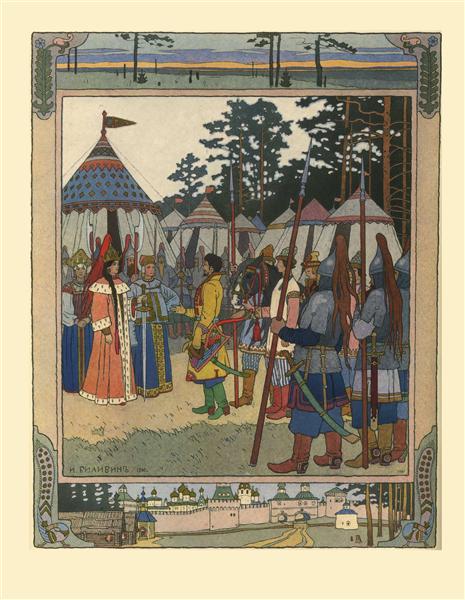
Marya Morevna standing before her armed host.
Marya Morevna as a commanding figure of authority.

Take, for instance, the tale of Marya Morevna. Near the beginning, in a scene reminiscent of the story “Bluebeard”, Marya warns her new husband, Prince Ivan, not to look in a certain closet while she is away. In Bluebeard, it is the wife who looks into a room or closet against her husband’s warning to discover the titular Bluebeard’s macabre habit of murdering all of his previous wives; the rest of the tale involves the wife outsmarting and escaping her deadly paramore. In Marya Morevna, Ivan finds a man chained in the closet, but it turns out that this man is actually an immortal villain Koschey the Deathless. Ivan’s kindness allows the now freed bony man to kidnap Marya, and the rest of the tale is about Ivan’s rescue of her.

Another famous Russian tale is that of the Frog Tsarevna (or frog princess). Frog princesses do appear in Western tales, even in a Disney movie, but the more well known version involves a frog prince. In these stories, the frog is betrothed to a girl and only gets transformed back to its princely form through a conveyance such as a kiss, being invited into the girl’s bed, or, my personal favorite, being thrown against a wall. The frog tsarevna needs to work quite a bit harder for her transformation, proving her ability to sew, cook, and perform other traditional domestic duties better than her sisters-in-law. In some versions, her husband discovers and tries to hide her frog skin, which only causes further problems and the need for a rescue from, who else, Baba Yaga (link).
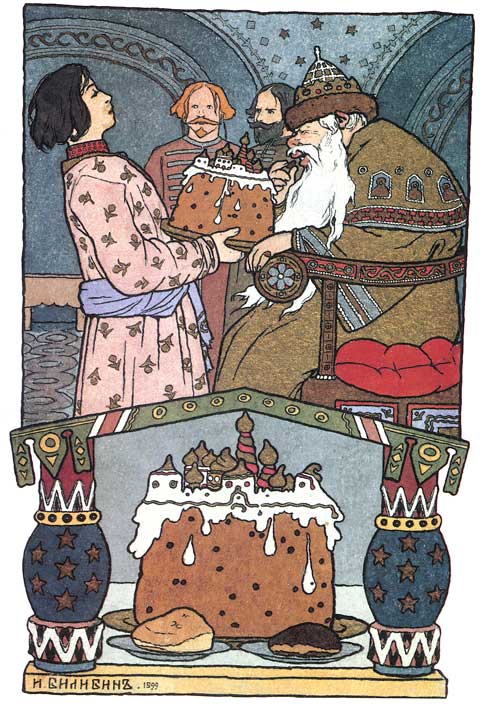
Prince Ivan presents a cake to his aged father.
No one bakes better cakes than the frog tsarevna.

Finally, we could look at the Tale of Tsarevich Ivan, the Firebird, and the Grey Wolf. Wolves almost always take the role of villains in Western tales. The most famous examples would be the ‘big bad wolf’ from Little Red Ridinghood and the Three Little Pigs, but they also to turn up in about every other Disney movie from Beauty and the Beast to Frozen. The grey wolf of the Russian tale, on the other hand, is a supernatural helper; he helps Ivan to rescue a princess, to capture the firebird, and he even, at one point, brings Ivan back to life. This is another tale that has lesser known Western analogues, though in these the helper is almost always a cunning fox, a creature that has enjoyed a more positive (though not unambiguous) depiction.

Illustration of a wolf's silhouette

I love how Russian tales offer an opportunity to view these familiar folktales in a new light. Given the recent wave of popularity of Eastern European motifs in shows like the Witcher and Shadow & Bone, I like picking apart what contributes to this setting. I’ve chosen these tales for comparison because they’re among the most popular in Russia and the West, respectively. But we can dig even deeper to find comparable tales.

The Aarne-Thompson-Uther index (or ATU) is an exhaustive list of folktale plots from around the world. Each plot type is numbered: so, for instance, the main plot of Marya Morevna is categorized as type 302, “Ogre’s Heart in the Egg.” Any tale from around the world in which a villain hides their heart or soul outside of their body (and there are many!) would receive the same classification. So what would we learn if we compared tales with the same classification? For instance, Cinderella vs Russia’s Vasilisa the Beautiful, both ATU 530? Sorry to end on a cliffhanger, but this is something I’d like to develop in future posts. Please subscribe below to stay tuned!

Categories
Uncategorized

Baba Yaga

In its second season, Netflix’s The Witcher has a new villain, the mysterious Voleth Meir. Unlike the creatures and characters in season one, and throughout the rest of this season, Voleth Meir was not featured in the original Witcher stories by Andrzej Sapkowski, nor did she appear in any of the Witcher video games by CD Projekt Red. However, the ‘Deathless Mother’ does have an origin in Slavic folklore: Baba Yaga, the mother of witches.

Art Nouveau illustration of a witch flying in a forest.
Baba Yaga riding in a mortar and pestle, how she does. Illustration by Ivan Bilibin.

The following contains minor spoilers for season 2 of the Witcher.

If the Netflix show is your first introduction to the Witcher franchise, you may not be aware of the story’s Polish pedigree. When you get past the elves, dwarves, and dragons, which have been standard fantasy fare since Tolkein, nearly all of the monsters that Geralt hunts have their origins in the myths and legends of eastern Europe. Some of these, like the striga, are not far from their folklore equivalents: the striga is a type of vampire, closer to what we might call a ghoul, but its bestial nature is more faithful to the actual legends than the suave image of vampires from Bram Stoker to Anne Rice and beyond. Others, like the kikimora, are a bit further from the source: a multi-legged monstrosity in the show and games, this creature is generally a birdlike humanoid in the old stories. Even the term ‘Witcher’ is based on a type of folkloric spellcaster called a ‘vedmak’ in Russian or ‘wiedźmak’ in Polish.

Baba Yaga is primarily associated with Russian folktales, but she does sometimes appear in Polish folktales, including under the monikers Jezibaba or Baba Jęzda. Baba Yaga’s most famous attribute is her house, a hut that stands on chicken legs, which makes a prominent appearance in the Netflix show. In a more subtle allusion to traditional tales, the visions that Francesca, Yennefer, and Fringilla have of figures cloaked in white, red, and black are much like the three riders who serve Baba Yaga and who themselves represent morning, day, and night. Even the way Voleth Meir, despite her obvious villainy, offers aid to these three women owes something to folklore.

Baba Yaga in Folklore

Baba Yaga appears in many fairy tales, but the most famous is probably that of Vasilisa the Beautiful. Vasilisa, sort of a Russian Cinderella, is sent by her stepmother into the woods to perish, but she instead finds the hut of Baba Yaga. Guided by a doll from her dead mother, Vasilisa is able to complete several impossible tasks for the crone, and thus avoid getting eaten. Rather, Baba Yaga gives Vasilisa a skull with burning eyes to light the girl’s way home, where she finds that no fire will light in the house. She offers the fire from the skull, but this consumes the wicked stepmother and her stepsisters, and Vasilisa quickly leaves the scene and eventually ends up marrying a prince.

Art nouveau illustration of a peasant girl holding a skull on a stick. The skull's eyes are glowing and in the background is a hut on chicken legs.
Vasilisa on her way home, with Baba Yaga’s hut in the background.

This is typical of Baba Yaga, she is both the monstrous, devouring ogre and the helpful donor. In some tales she is more one than the other, but in sum this is her character. There’s no character quite like her in other European folk tales, and she has a real staying power in Russian culture. Perhaps her uniqueness is also responsible for her appearances in Western media.

Baba Yaga in RPGs

Baba Yaga has a long history in roleplaying games, dating back to one of the earliest D&D supplements, 1976’s Eldritch Wizardry. Well, only her hut would appear in that book as an artifact, but it then became the location for an adventure in Dragon Magazine, then a standalone AD&D module, in which the mother of witches herself would appear. Baba Yaga’s Dancing Hut was reworked in Dungeon Magazine for 4th edition, and was also the centerpiece of Pathfinder’s ‘Reign of Winter’ adventure path. Baba Yaga is a major player in Kobold Press’ Midgard campaign setting, and even an elder vampire in Whitewolf’s ‘Vampire: The Masquerade.’ In the D&D adventures, Baba Yaga had an adopted daughter, Natasha, who was eventually identified as the same Tasha who created the Hideous Laughter spell and eventually a Cauldron of Everything in 5th edition.

Image of adventurers in front of a dancing hut, a leering witch in the background. Title reads 'The Dancing Hut of Baba Yaga'
The AD&D adventure, my first actual encounter with Baba Yaga.

Though not explicitly so, my latest 5e adventure, The Pub that Crawls, is an obvious homage to Baba Yaga’s hut, so I tried to lean into its associations throughout D&D’s history. In its various incarnations, the dancing hut was a place of weird whimsy, including a room with a decommissioned Soviet tank and one with a giant lizard monster in alternate reality Tokyo, to name a couple of the most memorable. It was a place where the sprawling multiverse of the D&D settings coalesced and branched out, and the Pub that Crawls does a bit of the same thing.

What’s next for Baba Yaga? Will she ever get an official stat block in 5th edition? Will she, er, will Voleth Meir come back for another season? Whatever happens, expect to see echoes of this character in the future, and watch out for huts on chicken legs.